1. Local Vision Statement
The Parish Council’s vision is to maintain a balance between urban development and green space, ensuring Haydon Wick ward and Priory Vale ward remain well connected, liveable and resilient communities. New developments across Swindon should not lead to increased congestion, surface water flooding or environmental pressure on this area.Growth must bring with it the infrastructure, flood alleviation measures and community investment needed to sustain a good quality of life. This includes protecting and enhancing local assets such as Mouldon Hill Country Park, Seven Fields Nature Reserve, Clifford’s/Haydon Meadow.This vision supports Swindon Borough Council’s wider objectives but places emphasis on shared responsibility for infrastructure delivery and environmental protection. Growth must not come at the expense of existing communities.Positive elements:• Recognises the value of balanced urban and green environments• Supports borough housing needs while protecting local character• Identifies specific community assets for protectionNegative elements:• Current plan places pressure on existing communities• Infrastructure and flood mitigation not guaranteed• Risk of loss of local environmental quality2. Spatial Strategy and Growth Areas
The parish is directly affected by growth at Tadpole, Kingsdown and Blunsdon. These developments increase traffic, place pressure on drainage systems and risk fragmenting ecological corridors. While new homes are needed, infrastructure must come first.These sites will generate additional demand on Thamesdown Drive, Cold Harbour Junction and the A419, which are already operating at capacity. They also impact water catchments linked to River Ray and Haydon Brook, increasing flood risk downstream.Growth can bring opportunities. New residents strengthen the local economy, support shops and services and help create a more vibrant community. Without matching investment in transport, flood mitigation and green space, these benefits will be outweighed by pressure on existing infrastructure.Positive elements:• Acknowledges housing need and economic contribution of growth• Recognises strategic locations of Tadpole, Kingsdown and Blunsdon• Opportunity to align infrastructure investment with new developmentNegative elements:• No funded infrastructure to support these allocations• Increased congestion and flood risk• Biodiversity and green corridors under pressure• Cumulative impacts not addressed in the plan3. Design Quality, Character and Heritage
New developments must learn from past mistakes. Car ownership remains the dominant form of transport in North Swindon. Inadequate parking provision in earlier developments has led to unsafe parking, blocked pavements and frustration for residents.Future design must acknowledge current behaviour and provide sufficient parking, safe walking routes and appropriate landscaping. This is essential for liveability.The heritage and identity of the parish are shaped by Mouldon Hill Country Park and the Swindon and Cricklade Railway, which provide a strong local sense of place. These assets should be considered when planning nearby growth.Positive elements:• Acknowledges importance of practical design standards• Recognises value of local heritage assets• Supports better landscaping and integrationNegative elements:• Earlier developments failed to meet parking demand• Poor integration with heritage and green assets• Design policy remains too general4. Housing Mix and Affordability
The parish has seen rapid housing growth dominated by similar housing types, creating limited choice for different age groups and income levels. Affordable housing remains a concern, with many residents priced out of the area they grew up in.The plan should provide a better mix of homes, including affordable starter homes, accessible properties for older residents and housing that meets the needs of a changing population.Rapid growth has outpaced the delivery of infrastructure, placing strain on roads, schools and community facilities. Future housing must be balanced with service provision and environmental protection.Positive elements:• Recognises housing diversity as a priority• Highlights affordability challenges• Links housing growth to infrastructure capacityNegative elements:• Lack of variety in housing stock• Limited affordable and accessible housing• Infrastructure has not kept pace with development5. Infrastructure and Phasing
The Local Plan recognises the need to align infrastructure with housing growth. References to Thamesdown Drive, Lady Lane, active travel and bus services show awareness of where key pressure points exist.The Infrastructure Delivery Plan is incomplete and unfunded for northern schemes. There is no clear commitment to extend Thamesdown Drive to Great Western Way. This missing link is one of the most critical infrastructure gaps in Swindon. Cold Harbour Junction is a long-standing bottleneck with no allocated funding. Tadpole Garden Village and Burcot Farm will add pressure to the A419, but the plan contains no access improvements to match.Fibre broadband was retrofitted in Priory Vale years after homes were occupied. Pavements were dug up repeatedly, causing damage and shortening their lifespan. Utilities and transport must be installed from the outset, not as afterthoughts.Positive elements:• Recognises Thamesdown Drive and key travel corridors• Mentions active travel and bus service improvements• Aligns with TR1, TR2 and IN2 on sustainable infrastructure• Acknowledges infrastructure must accompany growthNegative elements:• Infrastructure plan incomplete and unfunded for northern schemes• No Thamesdown Drive extension to Great Western Way• No Cold Harbour Junction upgrade• No A419 access improvements for Tadpole and Burcot Farm• No phasing triggers tied to occupation• Pavement damage due to late broadband installation• No strategic funding for northern routes• Allocations near Kingsdown and Blunsdon lack infrastructure plan6. Biodiversity, Nature Recovery and Green Space
Policies CSE8, EN1 and EN2 provide a framework for biodiversity net gain and green infrastructure. Recognition of Mouldon Hill Country Park as a strategic site is welcome.The plan fails to protect many other valued local spaces. These must be explicitly named and safeguarded:• Mouldon Hill Country Park as a major biodiversity asset• Clifford’s Meadow and Haydon Meadow as nationally important wildlife sites• Seven Fields Nature Reserve as a key ecological and community space• All parish managed open spaces and play areas• Goodearl, Rose Walk and Ventnor Close allotments as key food resilience and biodiversity sitesBiodiversity net gain must be delivered locally. Off-site delivery denies communities environmental benefits. Ecological corridors between Tadpole Field, Seven Fields, Mouldon Hill and Clifford’s Meadow must be mapped and protected.Positive elements:• CSE8 biodiversity net gain target• EN1 and EN2 link green space, health and climate• Mouldon Hill strategic recognition• Borough canopy target aligned with Great Western Community ForestNegative elements:• Clifford’s Meadow, Seven Fields and allotments not mapped or protected• Off-site biodiversity net gain allowed• No ecological corridor mapping• No parish canopy reporting• Allotments not protected• Habitat fragmentation risk• No biodiversity monitoring at parish level7. Climate Resilience and Surface Water Flooding
Flooding affects Haydon End, Oakhurst, Abbey Meads and Tadpole Garden Village. EN6, EN1 and EN2 set objectives but lack enforceable standards. The evidence is outdated and does not reflect repeated flood events since 2016.Hotspots such as Thames Avenue, Queen Elizabeth Drive and Tadpole Lane have experienced repeated failures. Abbey Meads floods after storms. These are not mapped or prioritised for action.SuDS are inconsistent. In Tadpole Garden Village, basins were left unadopted and poorly maintained. Developers have used underground tanks instead of natural infiltration. Older estates rely on traditional drainage. Without clear standards and adoption frameworks, SuDS will not be reliable.There are no measurable standards for permeable surfaces, canopy cover or shading. Mouldon Hill is isolated from surrounding areas and tree planting commitments have been scaled back. Green corridors are fragmented.No SuDS register exists. Responsibility is split between developers, management companies and the Borough Council. Growth at Kingsdown and NEV will increase pressure on River Ray and Haydon Brook. Policy IN2 covers potable and foul water but not surface water capacity.The evidence base predates major flood events and monitoring has not been published.Positive elements:• EN6, EN1 and EN2 provide a base framework• Green infrastructure recognised as part of the solution• Mouldon Hill identified as a strategic green siteNegative elements:• Outdated flood risk evidence• Hotspots not identified or prioritised• Weak SuDS standards• No adoption framework• No measurable design standards• No borough surface water strategy• Cumulative impacts unaddressed• Green commitments delayed• No SuDS register• Fragmented responsibility8. Air Quality, Noise and Pollution
Traffic is the primary source of air and noise pollution in Haydon Wick and Priory Vale. Pressure on Thamesdown Drive, Lady Lane and the A419 affects homes, schools and green spaces.The plan should include commitments to ongoing monitoring and improvement. Tree planting, EV charging, active travel routes and low emission infrastructure can mitigate harm. Air quality improvements must be sustained over time.Positive elements:• Recognises traffic pressures• Encourages investment in cleaner transport• Supports environmental improvementsNegative elements:• No specific commitments in the plan• Monitoring arrangements unclear• Air and noise quality likely to worsen without action9. Fair Funding and Delivery
Section 106 and CIL obligations have often been reduced through viability claims, shifting maintenance of parks, allotments and bins to parish taxpayers.Leisure facilities must be treated as essential infrastructure. Funding should be linked to growth.Developer bonds would ensure infrastructure delivery. If not delivered, funds can be used by the Borough or parish to complete works. This strengthens IN2 and increases accountability.Positive elements:• Growth linked to funding mechanisms• Recognises importance of leisure infrastructure• Developer bonds offer delivery securityNegative elements:• Current funding unreliable• Costs shifted to parishes• Leisure not linked to growth• No bond mechanism• Viability undermines delivery10. Community Identity, Education, Service and Leisure Protection
Haydon Wick and Priory Vale are under sustained pressure on services. Schools such as Haydonleigh, Greenmeadow and Orchid Vale expanded rapidly after housing growth. This relied on temporary buildings and overstretched older facilities.The plan does not safeguard land for future education. Secondary provision is limited. Growth at Kingsdown, Blunsdon and Tadpole will increase pressure.Leisure facilities are central to community life. Sports halls, community centres and play areas support health and connection. Without growth linked standards, service gaps will widen.Positive elements:• Recognises service pressure• Highlights education and leisure importance• Opportunity to link provision to growthNegative elements:• Pressures ignored• No safeguarded education land• No leisure provision targets• Catchment pressure will increase• No alignment between growth and services11. Employment, Skills and Digital Infrastructure
A strong Local Plan must support livelihoods, learning and connectivity. EC1 to EC3 and IN3 set objectives but do not deliver for North Swindon.Employment allocations are concentrated in the south and east. None are in North Swindon. This forces commuting and worsens congestion on Thamesdown Drive and the A419. Orbital Shopping Park provides mainly retail jobs.Skills and training are not integrated. North Star College provides excellent technical training in central Swindon but has no link to northern growth. Apprenticeship opportunities are limited.Digital infrastructure policy is outdated. Priory Vale was built without fibre broadband. Tadpole Garden Village had inconsistent speeds. Taw Hill still has poor mobile coverage. FTTP must be installed at build stage.There is no provision for incubators or co-working hubs. SMEs and professionals must operate elsewhere. This wastes opportunities for green tech and digital industries.Positive elements:• EC1 to EC3 set economic objectives• IN3 recognises digital infrastructure• Potential to link skills and growthNegative elements:• No employment land allocations in the north• Commuter pressure on key routes• Fibre broadband not required at build stage• Skills policy underdeveloped• No incubator or co-working provision• Poor digital coverage in some areas• Outdated evidence base12. Open Space Policy Links (HL2–HL3)
Mouldon Hill, Seven Fields, Clifford’s Meadow, Haydon Meadow, allotments and parish-managed play areas are central to community identity. These spaces should fall under HL2 and HL3 protection.A presumption should be introduced against their loss or reallocation unless agreed with the parish and replaced with land of equal or greater value. Biodiversity net gain should be tied directly to these sites, ensuring growth strengthens rather than weakens the parish environment.Positive elements:• Clear alignment with HL2 and HL3• Protects community and biodiversity assets• Encourages local delivery of biodiversity gainNegative elements:• Current plan does not provide HL2–HL3 designation• Smaller green spaces remain vulnerable• No local enforcement mechanism13. Monitoring and Accountability
Monitoring must be transparent. Borough wide indicators mask local problems. Parish level reporting would give residents clarity and ensure accountability.Developer bonds tied to milestones would improve delivery. Without this, past failures will be repeated.Positive elements:• Monitoring framework exists• Indicators create a baselineNegative elements:• Borough wide data hides local issues• No parish level reporting• No consequences for failure• Weak accountability14. Town Centre
The Local Plan’s commitment to regeneration, heritage protection and improved transport is welcome.Turnpike Junction remains outdated with no clear upgrade plan. Non central retail hubs such as Orbital Shopping Park are overlooked despite their importance to North Swindon.The plan mentions additional railway stations but provides no delivery plan. Improved rail access could ease congestion.Reopening of Oasis Leisure Centre would support regeneration and strengthen local leisure.Positive elements:• Commitment to regeneration• Heritage protection included• Transport connections identified• Oasis reopening offers opportunityNegative elements:• No delivery clarity or funding• Turnpike Junction ignored• Retail hubs overlooked• Rail opportunity missed• No parish involvement15. Partnership with Parish Councils
Parish councils maintain open spaces, allotments and facilities that shape local life. They understand local needs.The draft plan does not reflect their role. There is no structured involvement in infrastructure, biodiversity monitoring or flood risk planning. This weakens accountability and wastes capacity.Positive elements:• Parish councils hold local knowledge• Partnership would strengthen deliveryNegative elements:• Parish role unrecognised• No structured engagement• No devolution of responsibilities
Top 10 Policy Asks
- Infrastructure First: deliver transport, utilities and digital connectivity before homes are occupied
- Extend Thamesdown Drive: commit funding to extend to Great Western Way
- Upgrade Key Junctions: prioritise Cold Harbour and A419 access
- Protect All Green Spaces: protect Mouldon Hill, Clifford’s Meadow, Haydon Meadow and Seven Fields. Protect all parish open spaces and play areas. Protect Goodearl, Rose Walk and Ventnor Close allotments
- Deliver Biodiversity Net Gain Locally: require delivery in or adjacent to affected parishes
- Developer Bonds and Fair Funding: reintroduce bonds to secure delivery
- Leisure as Core Infrastructure: link leisure to population growth and protect existing sites
- Education and Community Services in Step with Growth: safeguard land and address capacity
- Employment and Digital Connectivity in the North: allocate employment land and require FTTP at build stage
- Formal Parish Role: embed parishes in infrastructure phasing, green space protection and monitoring
Closing Statement
This submission sets out clear expectations for infrastructure delivery, green space protection, biodiversity, climate resilience, economic balance and community identity.
Haydon Wick Parish Council is committed to working constructively with Swindon Borough Council to ensure the Local Plan delivers real benefits for existing and future residents.
This area has already experienced more than one wave of housing growth without the matching infrastructure. The next plan must get it right. The community deserves infrastructure, investment and protection that keeps pace with development.
Executive Summary
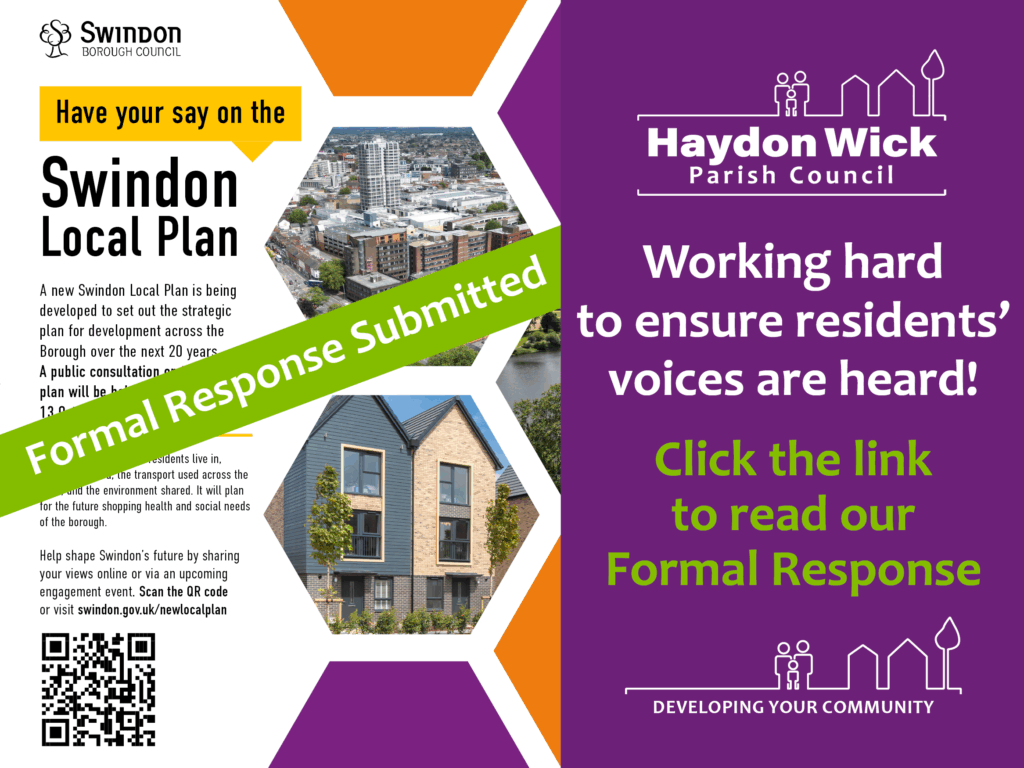
This submission sets out the position of Haydon Wick Parish Council on the Swindon Borough Council Local Plan 2023–2043. The parish welcomes the ambition to plan for Swindon’s future but believes that current proposals fall short of ensuring fair, sustainable and balanced growth for North Swindon.
The parish comprises Haydon Wick ward and Priory Vale ward, which together have already experienced significant housing growth without matching investment in infrastructure. This has placed pressure on roads, health services, schools, green spaces and digital connectivity.
There is strong community support for protecting valued local assets including Mouldon Hill Country Park, Seven Fields Nature Reserve, Clifford’s Meadow, Haydon Meadow, Goodearl allotments, Rose Walk allotments and Ventnor Close allotments. The Local Plan must give these spaces explicit protection and ensure biodiversity net gain is delivered locally, not traded away elsewhere.
Key infrastructure issues remain unresolved. These include the extension of Thamesdown Drive to Great Western Way, urgent upgrades to Cold Harbour Junction, improved A419 access for Tadpole and Burcot developments, and the installation of digital infrastructure before occupation of new homes. Failure to address these issues will deepen congestion, flood risk and inequality.
The parish calls for stronger policy on biodiversity, climate resilience, leisure provision, community services, employment and digital connectivity. Developer bonds should be reintroduced to secure delivery, and parish councils should be embedded as formal partners in monitoring and implementation.
Top Policy Asks
- Infrastructure first, with transport and utilities delivered before homes
- Extension of Thamesdown Drive and upgrades to key junctions
- Protection of all existing green spaces and allotments
- Local delivery of biodiversity net gain
- Developer bonds and fair funding for local services
- Leisure and education provision linked to population growth
- Investment in employment land and full-fibre broadband
- Transparent, parish-level monitoring and accountability
- Stronger climate resilience and flood alleviation commitments
- Formal partnership with parish councils on delivery
North Swindon has already absorbed more than one wave of housing growth without sufficient infrastructure. The next Local Plan must ensure that investment, protection and delivery match the scale of development. A fair, sustainable and transparent plan is essential to build trust and protect the future of our community.